


2nd CAM-Risk conference 8/10 April 2026
New risks and policy challenges.
The Global Financial Crisis (GFC), marked the end of the Great Moderation, a relatively prosperous period associated with stable macroeconomic regime conditions. Since then, the global economy has apparently entered a new phase characterized by a sequence of adverse financial, epidemic, geopolitical risks, let alone the dramatic issue of climate change. The widespread increase in inequality and political polarization favor the emergence of policies that might damage international trade. Technological developments (AI) might potentially reverse the slowdown in productivity growth that plagued developed economies since the end of the ‘90s, but they pose risks too, and require regulatory intervention. A similar concern arises for financial digitization. Last, but not least, sweeping US tariff increases in 2025 will reshape international trade flows, and their effects are still highly uncertain.
Europe is at a crossroads between fragmentation and decline and decisive progress towards deeper political integration is needed to strengthen its common external security, its social cohesion and the competitiveness of its firms.
Against these scenarios, the conference calls for contributions that analyze the nature of these risks and their policy implications. Topics of interest, without being exhaustive, concern
- Growth and business cycle analysis
- Quantitative Finance and Econometrics
- New risks and financial stability
- Migration, and the labor market
- International trade challenges
- Climate change and energy policies
- European issues and Geopolitical risks
- Ageing and the Progression of Disability: Insurance Models for Long-Term Care in Public and Private Systems
Oxford Economic Papers special section. Fiscal Policy: Risks and Emerging Challenges
Escalating uncertainty and significant policy shifts are reshaping economic and fiscal outlooks worldwide. Recent major tariff announcements by the United States, along with retaliatory measures from other countries, are contributing to financial market volatility and amplifying downside risks. Moreover, public finances are under considerable strain, and debt levels remain elevated in many nations. According to the latest IMF Fiscal Monitor, global public debt is projected to exceed 100 percent of GDP by 2029, reaching its highest level since 1948. The risk distribution is skewed toward even faster debt accumulation; with a 5 percent probability, debt could climb to 124 percent of GDP by 2029.
Additional challenges complicate the fiscal outlook: heightened uncertainty about economic activity and policy, rising yields in major economies, widening spreads in emerging markets, increased defense spending—particularly in Europe—and a difficult foreign aid environment for many low-income countries. Against this backdrop, fiscal policy must navigate a sharper trade-off between reducing debt, building buffers to manage uncertainty, and accommodating spending pressures—all amid weaker growth prospects, higher financing costs, and elevated risks.
Against this background, the OEP SI would look for contributions examining risks and new challenges affecting the design, the effectiveness as well as the sustainability of fiscal policy. Topics of interest include, but are not restricted to, the interplay between fiscal policy and:
· Debt sustainability and risks
· Fiscal-monetary interactions under uncertainty
· Climate risks
· Geo-economic fragmentation and (de)globalization
· Fiscal spillovers
· The macroeconomic effects of defense spending
· Risk identification and non-linear triggers
· Determinants of sovereign spreads
· Effects of policy on uncertainty and risk
· Design of policy for mitigation of risk
· Policy uncertainty and macro-financial impact
The conference organizers, in collaboration with the editors of Oxford Economic Papers (OEP), will invite authors of selected high-quality papers (up to five) that align with the journal’s scope and contribute to the recent debates featured in OEP, to submit their manuscripts for potential publication. The editors will facilitate an expedited review process, ensuring that all submissions undergo the standard double-blind peer review. Selected authors will be invited to submit their manuscripts via the journal site, clearly referencing the conference in their cover letter. These submissions will then be considered for inclusion as a special section within a regular issue of the journal.
Program Details
Keynote speakers
Klaas Knot (Former President of De Nederlandsche Bank and former Chair of the Financial Stability Board) TBA
Tomaso Aste (UCL)
Barbara Rossi (European University Institute (and UPF, on leave)) “Rethinking short-term real interest rates and term spreads using very long-run data”
Josef Teichmann (ETH Zurich) “Path dependent modeling in Economics, Finance and Technology”
Invited sessions
Bank of Italy session organizer: Iuri Marcucci (Bank of Italy)
Papers and presenters (in bold)
The efficiency of NextGenerationEU: Evidence from solar energy subsidies in Italy using satellite imagery
Benjamin Lietti (Paris-Saclay University), Jean-Charles Bricongne (Banque de France), Maximilian Freier (European Central Bank), Christian Huber (European Central Bank)
Evaluating Machine-Learning Methods for Macroeconomic Forecasting
Davide V. Bucci (Sveriges Riksbank), Dalibor Stevanovic (UQAM), Xin Zhang (Sveriges Riksbank)
Inflation Attitudes of Large Language Models
Nikoleta Anesti (Bank of England), Ed Hill (Bank of England), Andreas Joseph (Bank of England
Reddit's Pulse on US Inflation: Forecasting with Large Language Models
Andrea Del Monaco (European Central Bank), Luigi Longo (JRC - European Commission), Juri Marcucci (Bank of Italy), Irene Tafani (IMT School Lucca)
IMF session “Topic” organizer: Davide Furceri (IMF and University of Palermo)
Papers and presenters (in bold)
The Impact of Geopolitical Risk on Consumer Expectations and Spending.
Yuriy Gorodnichenko; Dimitris Georgarakos; Geoff Kenny (ECB) and Olivier Coibion
Scenario Synthesis and Macroeconomic Risk
Tobias Adrian, Domenico Giannone, Matteo Luciani (Board of Governors of the Federal Reserve System), Mike West
Interest Rate Uncertainty and Firm Decisions
Anne Duquerroy, Klodiana Istrefi (ECB), Sarah Mouabbi
Fiscal multiplier and economic risk
Francesco Frangiamore, Davide Furceri (IMF), Domenico Giannone.
Conference Program
The updated program is published here
Event Information
Conference Venue: The University of Pavia (Corso Strada Nuova, 65 - 27100 Pavia)
Deadlines and submission → click here!
Paper submission deadline: January 15, 2026
Notification: January 28, 2026
Registration: deadline is March 10, 2026
Late Registration: until March 25, 2026
Registration fee
Standard fee: €350 (Senior researchers); €150 (PhD students)
Late fee: €600 (Senior researchers); €250 (PhD students)
CONFERENCE PROGRAMME

International Fintech Research Conference - FINTECH2026
UNIVERSITY OF PAVIA | JANUARY 29-30, 2026
Corso Strada Nuova, 65 - 27100 Pavia – Italy
The Conference seeks to foster discussion and encourage collaboration among researchers across all areas of Fintech, offering a multidisciplinary platform for exchange. Submissions are invited on a wide range of Fintech topics, including but not limited to: theoretical foundations of Fintech (finance and economic analysis), machine learning applications in finance, cryptocurrencies and digital currencies, cybersecurity, neural network approaches in Fintech, smart contracts, peer-to-peer finance, big data analytics, nowcasting, financial text analysis, blockchain technologies, network analysis in finance, and behavioral finance.
An award will be given for the best paper presented at the Conference by young researchers.
This Conference marks the fourth edition of an annual initiative organized by the Fintech Research Network, led by a team of researchers active across all areas of Fintech. The Network is committed to advancing research in the field through a range of initiatives, including conferences, summer schools, workshops, seminars, and collaborative research projects within the broadly defined Fintech domain.
Organization
SCIENTIFIC COMMITTEE
Tomaso Aste, Matteo Barigozzi, Francesco Bartolucci, Emilio Barucci, Giacomo Bormetti, Andrea Consiglio, Stefania Corsaro, Luca Di Persio, Massimiliano Ferrara, Gianna Figà-Talamanca, Paolo Giudici, Fabrizio Lillo, Daniele Marazzina, Silvia Muzzioli, Claudio Tebaldi
LOCAL ORGANIZING COMMITTEE
Giacomo Bormetti, Riccardo Brignone, Paolo Giudici, Andrea Pallavicini, Emanuela Raffinetti, Alessandro Spelta, Lorenzo Trapani
Best Paper Award
The Organizing Committee establishes a prize for the best paper presented at the fourth International Fintech Research Conference by young researchers.
The call is available here.
Submission
The abstract/paper submission must be done through Microsoft CMT by clicking here. Please note that you will be required to create an account on Microsoft CMT.
Abstracts/Papers can be submitted by December 21, 2025. Notification of acceptance will be given by December 31, 2025. Conference registration for presenters: January 1-14, 2026.
Registration Fees
100,00 EUR: the fee covers coffee breaks, lunches, and the social dinner
60,00 EUR: for people attending the social dinner only
Registration and fee payment instructions
Registration will open on January 1st, 2026.
For speakers: After notification of acceptance, you will receive the instructions from Microsoft CMT.
For partecipants not presenting a paper: Please contact the Organizing Committee at fintech2026.pv@gmail.com.
Program
KEYNOTE SPEAKERS
- Agostino Capponi, Columbia University
- Frédéric Vrins, Université Catholique de Louvain
TOPIC SESSION SPEAKERS
- Daniele Bajoni, University of Pavia
- Alessandro Bisio, University of Pavia
| January 29th - Aula Volta, Corso Strada Nuova 65 |
| 8:45 - 9:15 | Registration |
| 9:15 - 9:30 | Opening |
| Decision-making - Chair: Tomaso Aste | |
| 9:30 - 9:50 | Emilio Barucci: Central Bank Digital Currency, Flight-to-Quality, and Bank-Runs in an Agent-Based Model |
| 9:50 - 10:05 | Alessandro Spelta: Conditional Flow Matching for Macroeconomic Dynamics: A Schrödinger Bridge Approach to Modeling Cross-Country GDP and Inflation |
| 10:05 - 10:20 | Giacomo Livan: Strategy and Game Co-evolution in Interacting Populations |
| 10:20 - 10:35 | Golnoosh Babaei: SAFE Generative Artificial Intelligence in Finance |
| 10:35 - 11:05 | Coffee Break - Saloni Rettorato |
| Best Paper Award Session - Chair: Emilio Barucci | |
| 11:05 - 11:25 | Fabio Baschetti: Joint Deep Calibration of the 4-factor PDV Model |
| 11:25 - 11:45 | Andrea Conti: Transfer Learning (Il)liquidity |
| 11:45 - 12:05 | Maria Elena Filippin: Central Bank Digital Currency: Demand Shocks and Optimal Monetary Policy |
| 12:05 - 12:25 | Luca Russo: Stock Returns Forecasting Using Stocktwits Data |
| 12:25 - 12:45 | Salvatore Scognamiglio: Tree-like Pairwise Interaction Networks |
| 12:45 - 13:45 | Lunch - Saloni Rettorato |
| Keynote Session - Chair: Paolo Giudici | |
| 13:45 - 14:45 | Frédéric Vrins: Beyond the Default: Drivers and Models of Credit Recovery |
| Reinforcement learning in finance - Chair: Stefania Corsaro | |
| 14:45 - 15:05 | Michele Trapletti: AI Hedging: from Vanilla Options to CVA |
| 15:05 - 15:25 | Michele Colombi: Deep Option Hedging From Simulation To Reality |
| 15:25 - 15:45 | Stefano Corti: Optimal Strategy and Deep Hedging for Share Repurchase Programs |
| 15:45 - 16:05 | Flavio Bazzana: From Information Asymmetry to Knowledge Asymmetry: Order Flow, Market Inelasticity, and Asset Pricing |
| 16:05 - 16:25 | Edoardo Vittori: Reinforcement Learning in Queue-Reactive Models: Application to Optimal Execution |
| 16:25 - 16:55 | Coffee Break - Saloni Rettorato |
| Topic Session on Quantum Computation - Chair: Andrea Pallavicini | |
| 16:55 - 17:25 | Alessandro Bisio: Quantum Computing: An (almost) gentle introduction |
| 17:25 - 17:45 | Francesca Cibrario: Autocallable Options Pricing with Integration-Based Exponential Amplitude Loading |
| Deep learning in finance - Chair: Daniele Marazzina | |
| 17:45 - 18:05 | Pietro Rossi: Learning the Exact SABR Model |
| 18:05 - 18:20 | Riccardo Brignone: Fast Bayesian Calibration of Option Pricing Models Based on Sequential Monte Carlo Methods and Deep Learning |
| 18:20 - 18:35 | Alessandro Piergallini: SAFE Deep Learning Models in Finance |
| 18:35 - 18:55 | Mattia Chiappari: Modeling Price Interdependencies between European Carbon and Electricity Markets: A Correlated Random Effect Approach |
| 20:00 - 23:00 | Social Dinner - Arnaboldi Palace, Via Varese 8 |
| January 30th - Aula Scarpa, Corso Strada Nuova 65 |
| DeFi and Crypto - Chair: Claudio Tebaldi | |
| 8:30 - 8:50 | Manuel Naviglio: Predicting the Success of New Crypto-tokens: The Pump.fun Case |
| 8:50 - 9:10 | Farhana Raheem: Relationship between Cryptocurrencies and Energy Consumption |
| 9:10 - 9:30 | Lidia Brailovskaia: Swaps and Options on Ethereum Gas Fees: A Framework for Risk Management in DeFi |
| 9:30 - 9:50 | Uwakmfon Offiong: A Conceptual Process Framework for Fintech Implementation in Microfinance Companies |
| 9:50 - 10:10 | Gabriele Ciotti: Market Making Strategies in Multi Order Book Environments: An Extension of the Avellaneda-Stoikov Model for Cryptocurrency Markets |
| 10:10 - 10:40 | Coffee Break - Retro Bistrot Vigoni, Corso Strada Nuova 108 |
| Keynote Session - Chair: Fabrizio Lillo | |
| 10:40 - 11:40 | Agostino Capponi: Decentralized Settlement Systems: Frontrunning, Inefficiency, and the Rise of Private Pools |
| Learning - Chair: Gianna Figà-Talamanca | |
| 11:40 - 12:00 | Gloria Polinesi: Geometric Ensemble Learning |
| 12:00 - 12:20 | Thomas Grava: Optimal Training of the Online Newton Algorithm based on Conformal CUSUM |
| 12:20 - 12:35 | Rasha Zieni: A Detection-Loss Based Explainability Score for Object Detection Models |
| 12:35 - 13:35 | Lunch - Retro Bistrot Vigoni, Corso Strada Nuova 108 |
| Topic Session on Quantum Neural Networks - Chair: Giacomo Bormetti | |
| 13:35 - 14:05 | Daniele Bajoni: Neural networks and machine learning on existing quantum computing processors |
| 14:05 - 14:20 | Vasily Kolesnikov: SAFE Quantum machine learning |
| 14:20 - 14:35 | Best paper award |
| Energy and sustainable finance - Chair: Silvia Muzzioli | |
| 14:35 - 14:55 | Giovanni Bonaccorsi: Carbon Prices, Transmission Constraints, and Electricity Prices Forecasting: Evidence from a Deep Learning Analysis |
| 14:55 - 15:15 | Francesco Rania: Sustainable Digital Finance: ESG Modeling, Machine Learning, and Systemic Risk in FinTech Ecosystems |
| 15:15 - 15:35 | David Barilla: Machine Learning and ESG Integration in Portfolio Optimization: Theory and Evidence |
| 15:35 - 15:50 | Arianna Agosto: Dealing with the Divergence of ESG Scores: a Wasserstein-distance-based Method |
| 15:50 - 16:20 | Coffee Break - Retro Bistrot Vigoni, Corso Strada Nuova 108 |
Acknowledgements
The Microsoft CMT service was used for managing the peer-reviewing process for this conference. This service was provided for free by Microsoft and they bore all expenses, including costs for Azure cloud services as well as for software development and support.
The Organizing Committee acknowledges financial support from Dipartimento di Eccellenza MUR 2023-2027, AMASES, Polimi - Department of Mathematics, and PRIN project Fin4Green.
Contacts
For any question, please send an email with subject FINTECH2026 to fintech2026.pv AT gmail.com
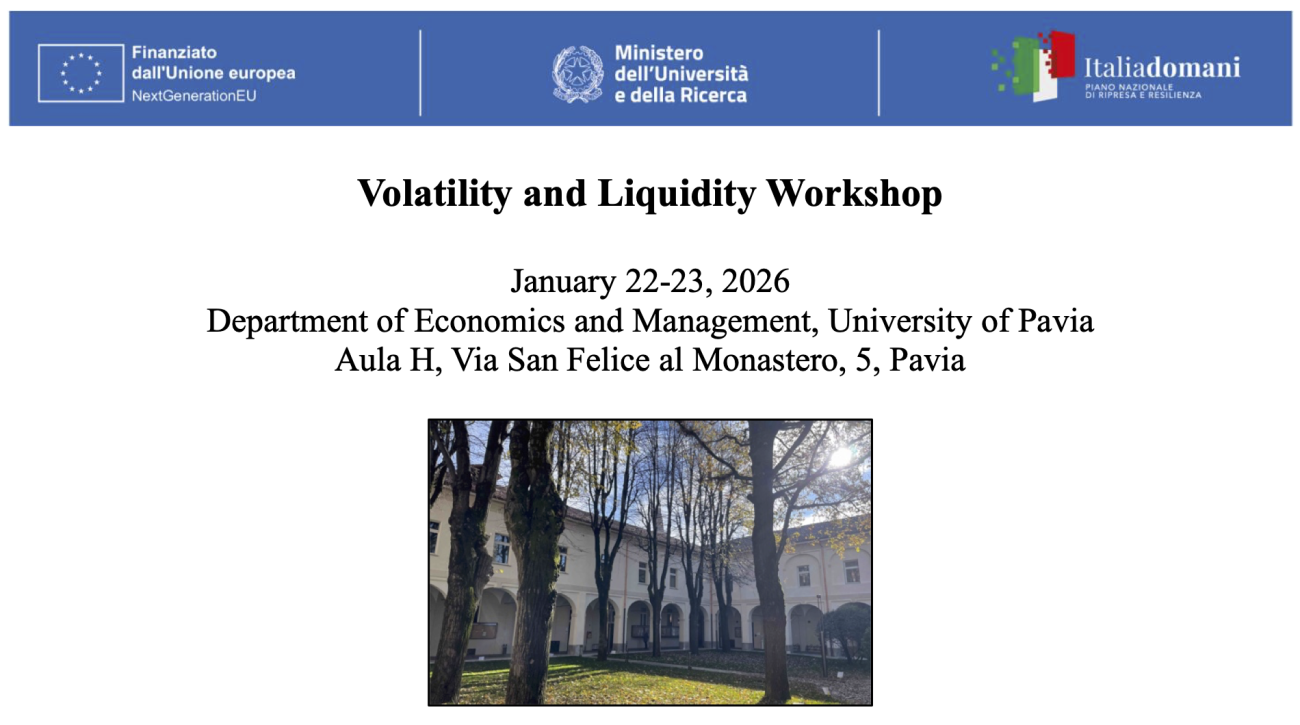
In an era defined by rapid, unprecedented disruption—ranging from financial crises to climate change to global pandemics—our socio-economic systems are being reshaped before our eyes. As market participants evolve and adapt, the foundations of econometric modeling shift, creating new challenges and opportunities.
This workshop brings together world-class experts at the forefront of modeling time-varying parameters, such as volatility and liquidity. We uncover the forces driving these dynamics and explore cutting-edge insights essential for safeguarding and strengthening the resilience of the global financial system.
Venue
Aula H, Via San Felice al Monastero 5, Pavia
Organizing Committee
- Giacomo Bormetti
- Riccardo Brignone
- Eduardo Rossi
- Lorenzo Trapani
Keynote Speakers
- H. Peter Boswijk, University of Amsterdam
- André Lucas, VU University Amsterdam
Invited Speakers and Discussants
- Giuseppe Buccheri, University of Verona
- Andrea Bucci, University of Macerata
- Leopoldo Catania, Aarhus University
- Enzo D’Innocenzo, University of Bologna
- Emilija Dzuverovic, Ca’ Foscari University of Venice
- Christian Francq, ENSAE Paris
- Giampiero Gallo, New York University in Florence
- Emanuele Guidotti, University of Lugano
- Nikolaus Hautsch, University of Vienna
- David Itkin, London School of Economics and Political Science
- Fabrizio Lillo, Scuola Normale Superiore Pisa
- Elisa Ossola, University of Milano Bicocca
- Angelo Ranaldo, University of Basel
- Roberto Renò, ESSEC Business School Paris
- Mirco Rubin, EDHEC Business School Nice
- Paolo Santucci De Magistris, LUISS Rome
- Luca Trapin, University of Bologna
- Fabio Trojani, University of Geneva
- Giovanni Urga, Bayes Business School, City St George’s University of London
- Pierluigi Vallarino, University of Lugano
- Linqi Wang, Queen Mary University of London
- Shixuan Wang, University of Reading
Program schedule
| Day one - January 22nd, 2026 | |
| 11:45 - 12:00 | Opening |
| 12:00 - 13:00 | Keynote speech (45 mins + Q&A) |
| 13:00 - 14:15 | Light lunch |
| 14:15 - 16:15 | I Volatility Session* |
| 3 Invited (30 mins) plus 3 Discussants (10 mins) | |
| 16:15 - 16:45 | Coffee break |
| 16:45 - 18:45 | I Liquidity Session‡ |
| 3 Invited (30 mins) plus 3 Discussants (10 mins) | |
| 20:00 - 22:30 | Social dinner - Locanda del Carmine |
| Day two - January 23rd, 2026 | |
| 9:30 - 11:30 | II Liquidity and Systemic Risk Session‡ |
| 3 Invited (30 mins) plus 3 Discussants (10 mins) | |
| 11:30 - 12:00 | Coffee break |
| 12:00 - 13:00 | Keynote speech (45 mins + Q&A) |
| 13:00 - 14:15 | Light lunch |
| 14:15 - 16:15 | II Volatility Session* |
| 3 Invited (30 mins) plus 3 Discussants (10 mins) | |
| 16:15 - 16:30 | Closing |
Program
| Day one - January 22nd, 2026 |
| 11:45 - 12:00 | Opening |
| 12:00 - 13:00 | Keynote speech - Chair: Eduardo Rossi H. Peter Boswijk, ‘Characteristic function-based factor modelling of affine jump diffusions using options’ |
| 13:00 - 14:15 | Light lunch - Sala lettura Chiesa (Palazzo San Felice) |
| 14:15 - 16:15 | I Volatility Session* - Chair: Giacomo Bormetti
|
| 16:15 - 16:45 | Coffee break - Sala lettura Chiesa (Palazzo San Felice) |
| 16:45 - 18:45 | I Liquidity Session‡ - Chair: Lorenzo Trapani
|
| 20:00 - 22:30 | Social dinner - Locanda del Carmine, Piazza del Carmine 7/A |
| Day two - January 23rd, 2026 |
| 9:30 - 11:30 | II Liquidity and Systemic Risk Session‡ - Chair: Eduardo Rossi
|
| 11:30 - 12:00 | Coffee break - Sala lettura Chiesa (Palazzo San Felice) |
| 12:00 - 13:00 | Keynote speech - Chair: Lorenzo Trapani André Lucas, ‘Spectral Dynamic Copula Modeling’ |
| 13:00 - 14:15 | Light lunch - Sala lettura Chiesa (Palazzo San Felice) |
| 14:15 - 16:15 | II Volatility Session* - Chair: Riccardo Brignone
|
| 16:15 - 16:30 | Closing |
Acknowledgements
The Organizing Committee acknowledges financial support from Dipartimento di Eccellenza MUR 2023-2027.
* The Volatility Sessions are funded within the PRIN2020 project “Dynamic models for a fast-changing world: An observation-driven approach to time-varying parameters,” CUP F13C22002220001. Project number: 20205J2WZ4.
‡ The Liquidity Sessions are funded within the PRIN2022 project “Monitoring Risks in Financial Markets,” CUP: F53D23004210006. Project number: 2022NEL482.
Contacts
For any questions, please email the members of the Organizing Committee (name.surname@unipv.it) with the subject “Volatility and Liquidity @Unipv”.
The workshop aims to give an overview on some recent advances in the field of variational analysis and optimization focusing on both theory and applications.
The workshop will take place in Pavia on September 8-9, 2025.
The activities will take place on September 8 in aula Volta, Strada Nuova 65, Pavia and on September 9 in the former church in via San Felice 5.
For more information, please click here.

7 February 2025
CAMRisk and RCEA Europe jointly organize this workshop that gathers a number of invited speakers to discuss their latest research. The workshop is open to the participation of interested researchers and PhD students.
Location: Room Scarpa, S.da Nuova, 126b, 27100 Pavia PV
Zoom broadcast link: https://unipv-it.zoom.us/j/92356701195?pwd=bxpAe9PQAA3KENnNdQ3Y8hY2aJvSuV.1
ID meeting: 923 5670 1195
Access code: 746402
9.15 - 9.30 Workshop opening - E. Rossi (Pavia), C. Morana (RCEA, Milano Bicocca)
Chair: P. Benigno (BERN, RCEA)
9.30 F. Bilbiie (Cambridge) "HANKSSON",
Discussant M. D'amico (Uppsala)
10.20 J. Galì (Pompeu Fabra) "Heterogeneity and Aggregate Fluctuations: Insights from TANK Models"
Discussant E. Santoro (UCSC Milano)
11.10 -11.40 Coffee break
Chair: P.Tirelli (Pavia)
11.40 J. Hazell (LSE) "Do Deficits Cause Inflation? A High Frequency Narrative Approach"
Discussant I. Petrella (Collegio C. Alberto Torino)
12.30 A. Burya (Bern) "Monetary Policy under Labor Market Power"
Discussant D. SIena (Polimi)
13.20 - 14.20 Lunch
Chair: G. Ascari (Pavia)
14.20 M. Del Negro (FRSB New York) “Is the Green Transition Inflationary?”
Discussant B. Grassi (Bocconi)
15.10 A. G. Karantounias (Surrey) "Optimal Climate Policy in a Global Economy"
Discussant E. Campiglio (Bologna)
16.00 A. Ferrero (Oxford) "Optimal Stabilization Policies In the Wake of Large Shocks"
Discussant L. Iovino (Bocconi)
16.50 End of workshop
Organizing committee
Pierpaolo Benigno (Bern and RCEA)
Claudio Morana (Milano-Bicocca, CefES and RCEA)
Patrizio Tirelli (Pavia, CefES and RCEA)
1st CAM-Risk conference - 18-20 December 2024
New risks and policy challenges.
The Global Financial Crisis (GFC), marked the end of the Great Moderation, a relatively prosperous period associated with stable macroeconomic regime conditions. Since then, the global economy has apparently entered a new phase characterized by a sequence of adverse financial, epidemic, geopolitical risks, let alone the dramatic issue of climate change. The widespread increase in inequality and political polarization favor the emergence of policies that might damage international trade. Technological developments (AI) might potentially reverse the slowdown in productivity growth that plagued developed economies since the end of the ‘90s, but they pose risks too, and require regulatory intervention. A similar concern arises for financial digitization.
Europe is at a crossroads between fragmentation and decline and decisive progress towards deeper political integration needed to strengthen its common external security, its social cohesion and the competitiveness of its firms.
Against these scenarios, the conference calls for contributions that analyze the nature of these risks and their policy implications. Topics of interest, without being exhaustive, concern
- Growth and business cycle analysis
- Quantitative Finance and Econometrics
- New risks and financial stability
- Migration, trade and the labor market
- Climate change and energy policies
- European issues
- The economic, social and political impact of COVID-19 and the risks of future epidemics
Conference programme
Keynote speakers
- Thorsten Beck (European University Institute) "Emerging risks and regulatory and supervisory responses"
- Domenico Giannone (University of Washington) "Debt at Risk"
- Peter Tankov (ENSAE ParisTech) "Energy transition under scenario uncertainty"
Keynote panelists
- Lucia Alessi (European Commission – Joint Research Centre)
- Pasquale Della Corte (Imperial College, London)
- Luisa Lambertini (USI)
Click here to see the conference programme
Event Information
Conference Venue: The University of Pavia (Corso Strada Nuova, 65 - 27100 Pavia)
The registration deadline is the 5th of November.
Deadlines and submission
Paper submission deadline: September 30, 2024
Notification: October 15, 2024
Registration: November 5, 2024
Late Registration: November 10-20, 2024
Registration fee
Standard fee: €250 (Senior researchers); €150 (PhD students)
Late fee: €500 (Senior researchers); €260 (PhD students)

6 February - 1:00 pm - Common Room
Antonio Balzanella (Università degli Studi della Campania Luigi Vanvitelli) - "Optimal transport theory with application to Clustering and Co-clustering"
20 February - 1:00 pm - Common Room
Fabio Trojani (University of Geneva) - "Tradable Factor Risk Premia and Oracle Tests of Asset Pricing Models"
26 February - 1:00 pm - Sala Consiglio
Matteo Sandi (Università Cattolica-Milan) - "Sentencing severity and domestic violence: Evidence from Brazil"
1 March - 1:00 pm - Sala Consiglio
Paolo Santucci de Magistris (LUISS) - "Intermittency and the Potential of Wind Energy for CO2 Abatement"
5 March - 12:00 pm - Common Room
Eleonora Grassucci (Università La Sapienza) - "Quaternion machine learning"
11 March - 1:00 pm - Common Room
Orla Doyle (University College Dublin) - "The effectiveness of early life investments: evidence from the preparing for life trial"
18 March - 1:00 pm - Common Room
Stefano Filomeni (Essex Business School) - "Does soft information mitigate gender bias in corporate lending?"
25 March - 1:00 pm - Common Room
Sergio Galletta (ETH Zurich) - "War violence exposure and tax compliance"
8 April - 5:00 pm - Common Room and online (MEDEA/Economics Seminar)
Mateo Montenegro (TSE) - "Job Retention at Scale"
7 May - 1:00 pm - Common Room
Esther Ruiz (Universidad Carlos III de Madrid) - "Expecting the unexpected: Stressed scenarios for economic growth"
13 May - 12:30 pm - Common Room
Lucia Paci (Università Cattolica del Sacro Cuore) - "Bayesian inference of spatio-temporal modeling, Graphical models, Ecological and Environmental applications"
20 May - 1:00 pm - Common Room
Luca Gambetti (Universitat Autònoma de Barcelona) - "Asymmetric monetary policy tradeoffs"
27-28 April 2023: Statistics for Data Science and Artificial Intelligence
Web page
13-14 April 2023: 2nd EFCG - Diversity challenges for a sustainable Fintech